Create the space to think
With January being a time for resolutions, the same themes appear year after year.
'Take more time for myself.'
'Find better balance.'
'Be more productive.'
'Manage my time better.'
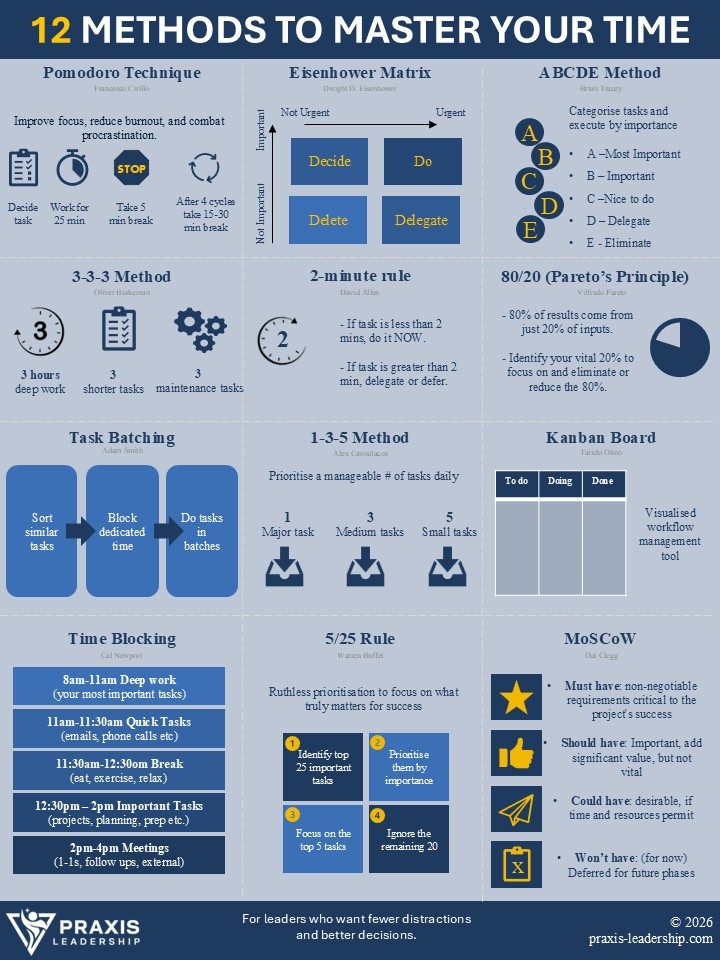
The intention is good, but resolutions without structure rarely last. So here are 12 time management tools to help bring a little more order to your work and life, and to restore some calm as we move into 2026.
Time management comes up in almost every training room I walk into. It shows up as a joke about being out of the office for a day and needing to catch up. It’s a quiet admission of always feeling behind. It’s the frustration of not being able to switch off. People aren’t short on effort. They’re lack clarity. When everything feels like a priority, the reality is that nothing is.
To make things worse, we’re more connected than ever, and that’s another part of the problem. Our days are packed with emails and meetings. Messages arrive, and are expected to be responded to, instantly. The notifications never stop! There’s an unspoken pressure to always be available, responsive, and switched on. Over time, this “always on” state becomes normal, and pausing to think or prioritise before acting can start to feel uncomfortable, even wrong.
The result is predictable: your days become reactive, attention drifts, and work follows you home, not because you care too much, but because the feeling of being behind never really goes away. No wonder it’s hard to think clearly about what actually matters.
This is where time management really earns its place. Not as a way to squeeze more into the day, but as a way of creating distance. Space to think. Space to choose. Space to lift your head above all the noise and act deliberately rather than react automatically.
I often talk about the importance of stepping back and taking a moment. In the military, we called it a condor moment. (Yes, borrowed from the 1980s cigarette advert!) When you step back from the immediate detail, priorities become clearer and decisions improve. That perspective is almost impossible to find when you’re stuck in a constant cycle of reacting.
Time management tools help because they slow things down just enough to make that pause possible. The Eisenhower Matrix helps you question urgency. Time blocking protects thinking time before it disappears. The Pomodoro Technique builds natural breaks into work that otherwise never seems to end. Simple tools like Kanban boards or the 1-3-5 method stop work from living entirely in your head.
You don’t need all of them. In fact, trying to use everything usually adds to the pressure. Pick one tool and try it for a week. Pay attention to how it affects your focus, your energy, and how your day feels. If it works, great. If it doesn’t, move on. There are plenty of options, and this is about finding what works for you.
What really matters is the pause these tools create. That pause is where you take back control. It’s where you stop being permanently “on” and start acting with intention. Good time management doesn’t make you slower. It gives you room to think, to recover, and to work in a way that lasts.
If you’re already starting to feel behind, sometimes the most productive thing you can do is to step back and take a breath. Clarity comes when you stop reacting and start choosing how your time is spent.